

Quick Answer
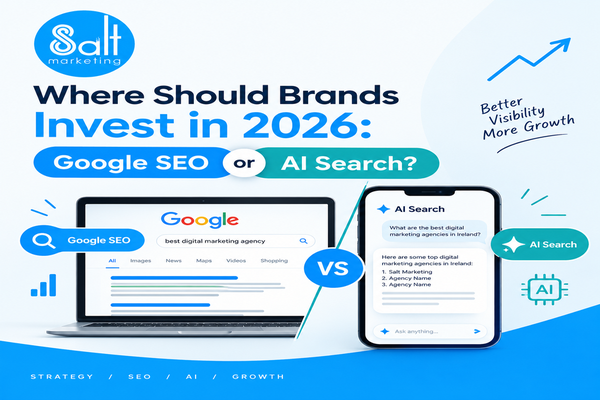
Invest in both, but build in the right order. Google SEO is still the foundation, because AI search tools mostly pull their answers from content that search engines can already find, understand and trust. Once that foundation is solid, add AI search optimisation (also called generative engine optimisation, or GEO) on top.
If your budget only covers one thing this year, put it into SEO fundamentals first. Most of that work also makes you more visible in AI answers.
Here is the short version:
- Fix your SEO foundation (technical health, helpful content, local signals, reviews).
- Layer on AI search work (clear answers, structured data, brand mentions, authority).
- Measure both and shift budget based on what brings leads, not just clicks.
What Is Actually Changing in Search?
Search used to be a list of ten links. Today, many searches start with a direct answer.
Google’s AI Overviews now appear on a large share of searches. One 2026 statistics roundup puts it at up to 47% of Google results, depending on query type, and says clicks on traditional links fall by around a third when an AI Overview is shown. At the same time, people are asking ChatGPT, Gemini, Claude and Perplexity for recommendations.
Two things are true at once:
- Zero-click answers are reducing raw traffic for many informational queries.
- AI referral traffic is still small for most sites. Industry analysis has put it at roughly 1–2% of referrals compared with traditional search, and around 0.3% for small sites in one data set.
So the real shift isn’t “SEO is dead”. It’s that visibility now includes being mentioned and cited, not just being clicked.
Is SEO Still Worth It in 2026?
Yes. Here is why.
- AI answers are built on search foundations. Google says its generative search features rely on its core ranking and quality systems, so a page that Google can’t find or trust is unlikely to be used. Most AI tools that browse the web also start from a search index.
- The overlap is big. Practitioners estimate that classic SEO and AI search optimisation share roughly 80% of the same work. Treat that as a rule of thumb rather than a hard figure, but it matches what we see: good content, clean technical set-up and strong reputation help in both places.
- Search still drives buying intent. A person searching “emergency plumber near me” or “Shopify SEO agency Dublin” is ready to act. Those searches still send people to websites and phone calls.
If you want a refresher on what a solid foundation includes, our SEO services page covers keyword strategy, on-page and off-page work, and reporting.
What Is AI Search Optimisation (GEO)?
AI search optimisation is the practice of making your brand easy for AI tools to understand, trust and recommend. You may also see it called GEO, AEO (answer engine optimisation) or “AI SEO”. They describe the same job: getting cited when an AI answers a question instead of listing links.
In practice, it means:
- Giving direct, self-contained answers to real customer questions.
- Using structured data (schema) so machines can read who you are, what you sell and where you operate.
- Earning third-party proof: reviews, press mentions and links from respected sites.
- Keeping your details consistent across your website, Google Business Profile and social channels.
Research cited in one SEO guide found that adding statistics, clear sources and authoritative wording lifted visibility in AI-generated answers by up to 30–40% in experiments. That’s a controlled test, not a guarantee, but it shows that clarity and evidence matter.
Google SEO vs AI Search: A Side-by-Side Look
| Key Point | Google SEO | AI search (GEO) |
|---|---|---|
| Main goal | Rank pages and earn clicks | Be cited or recommended in answers |
| Where you show up | Search results, maps, snippets | Smaller, but growing and often high-intent |
| Traffic today | Large and measurable | Smaller, but growing and often high-intent |
| Key signals | Relevance, links, technical health, E-E-A-T | Clarity, authority, brand mentions, structured data |
| Measurement | Mature (Search Console, analytics) | Still maturing; few reliable tools |
| Time to results | Typically months | Often similar, because it builds on SEO |
One practical point: Google Search Console doesn’t report AI Overview performance separately, so tracking AI visibility takes extra effort. Expect some manual testing.
How Should You Split Your Budget in 2026?
There is no universal formula, but here is a sensible starting point for most Irish SMEs. Treat these percentages as a rule of thumb to adjust, not a rule.
- About 70% on SEO foundations. Technical health, helpful service and product pages, local SEO, link building and reviews.
- About 20% on AI search optimisation. Question-led content, FAQs, schema markup, digital PR and brand mentions.
- About 10% on measurement and testing. Manual AI prompt checks, tracking referral sources, and reviewing which pages get cited.
Adjust it based on your business:
- Local service business (trades, clinics, professional services): weight more towards local SEO and reviews. For more on this, read our guide on Google Maps vs AI search and where local customers will find you.
- Online shop: invest in product page quality, buying guides and e-commerce SEO. AI tools increasingly answer “what’s the best X for Y” questions.
- B2B or SaaS: put more into expert content and third-party mentions, since buyers often research with AI before they ever contact you.
What to Do First: A 6-Step Plan
- Audit your site’s health. Check indexing, speed, mobile usability and broken pages. A site Google can’t crawl properly won’t be cited by anyone.
- Answer real questions clearly. For each key service, write a page or FAQ that opens with a 40–60 word direct answer, then goes deeper. Our content marketing team builds content this way.
- Show real experience. Add author names, credentials, case studies and original examples. This is the heart of Google’s E-E-A-T guidelines (Experience, Expertise, Authoritativeness, Trustworthiness).
- Add structured data. Use schema for your organisation, services, products, reviews and FAQs.
- Build trust off your website. Collect genuine Google reviews, earn press or industry mentions, and keep your Google Business Profile accurate. Our brand reputation management service supports this.
- Test and track. Each month, ask ChatGPT, Gemini and Google the questions your customers ask. Note whether you’re mentioned, who is, and which pages get cited.
Mistakes to Avoid
- Dropping SEO to “chase AI”. You’d lose the foundation AI relies on.
- Mass-producing AI-written pages. Google’s September 2026 spam update was a reminder that scaled, low-value content is risky. We broke it down in Google September 2026 Spam Update: What You Need to Know.
- Keyword stuffing for AI. Clear, natural writing performs better than repeating phrases.
- Ignoring site maintenance. Hacked pages, broken links and outdated information damage trust. Regular website maintenance helps.
- Judging success on clicks alone. Brand mentions in AI answers can build awareness even without a visit.
- Expecting overnight results. Authority takes time to build.
How Salt Marketing Approaches It
At Salt Marketing, we treat AI search as an extra layer on top of strong SEO, not a replacement. Our GEO-AI SEO service follows what we call the “Brain + Proof” approach:
- Brain: a deep library of expert content (service pages, guides, FAQs) that shows you know your subject.
- Proof: reviews, mentions and links from other trusted sources that back up what you say.
Our Dublin-based team combines SEO, content, technical and digital PR specialists, and we use AI to speed up research, not to write your final copy. If you’d rather have a full team handle everything, our Marketing as a Service (MaaS) model covers SEO, content, paid media and reporting under one roof. You can see how we’ve helped other businesses in our case studies.
Frequently Asked Questions
Q. Should I invest in SEO or AI search in 2026?
A. Invest in SEO first, then add AI search optimisation. AI tools mostly draw on content that search engines can already find and trust, so SEO work supports both.
Q. Is SEO dead because of AI?
A. No. SEO is changing, not disappearing. Traffic for simple informational queries is under pressure, but search still drives high-intent visits, calls and sales. The goal now includes being cited in AI answers as well as ranking.
Q. What is the difference between SEO and GEO?
A. SEO helps your pages rank in search results. GEO (generative engine optimisation) helps AI tools understand, trust and cite your brand in their answers. They overlap heavily and work best together.
Q. How do I appear in Google AI Overviews?
A. There’s no separate trick. Google’s guidance is that normal search best practice applies. Publish helpful, accurate, well-structured content, show real expertise, keep your site technically healthy and build a strong reputation.
Q. How can I get my business cited by ChatGPT or Gemini?
A. Answer customer questions clearly on your site, use structured data, earn reviews and third-party mentions, and keep your business details consistent online. No one can guarantee a citation, but these steps improve your chances.
Q. Does AI search send much traffic yet?
A. Not for most sites. Referral traffic from AI tools is still small compared with Google. But it is growing, and the visitors who do arrive may be further along in their decision, so it’s worth preparing now.
Q. Can I use AI to write my website content?
A. You can use AI for research and outlining, but publishing generic, unedited AI content is risky and rarely stands out. Add real expertise, original examples and human editing.
Q. How long does it take to see results?
A. SEO is typically a months-long effort. AI search visibility builds on the same foundation, so expect a similar timeline. Competition and your starting point make a big difference.
Q. How do I track AI search performance?
A. Start with manual checks: ask AI tools your customers’ questions and record whether you appear. Also watch referral traffic from AI platforms in your analytics and monitor branded search growth. Dedicated tracking tools exist but are still developing.
Q. Do small local businesses need AI search optimisation?
A. Yes, but keep it simple. Focus on local SEO, accurate listings, strong reviews and clear service pages. Those basics help you appear in both Google and AI answers.
Conclusion
The best answer to “Google SEO or AI search?” is SEO first, AI search on top, measured together. Search is becoming more conversational, but the winners in 2026 will still be the brands that publish genuinely helpful content, prove their expertise and earn trust across the web.
Start with a solid foundation, add the AI-focused layers step by step, and review your results every quarter.


Need Help With Your Project?